If you are dealing with aggressive debt collectors calling about an account from years ago, you may be wondering if they can still legally take you to court. The answer depends on understanding the statute of limitations on debt by state — a important legal concept that helps determine whether a lawsuit may be timely, subject to state law and the type of debt.

When a debt passes its statute of limitations, it becomes what is known as “time-barred debt.” While the debt itself does not magically disappear, a creditor or collector may face limits on suing over the balance, but the effect depends on state law, defenses, and the timing of the claim. However, the rules surrounding these time limits are complex. Because the statute of limitations on debt by state varies significantly, the deadline depends on where you live and the type of debt you owe. Furthermore, certain innocent actions—like making a small “good faith” payment—can inadvertently restart the clock, giving collectors a fresh opportunity to drag you into court.
At The Debt Survival Guide, our team brings 45 years of CPA expertise to help you navigate these challenging situations. In this comprehensive guide, we will explain exactly how the statute of limitations on debt by state works, provide a state-by-state overview, and detail what you should do if you are contacted about an expired debt. Use the statute of limitations on debt by state as a starting point, not a substitute for current state-specific advice.
Table of Contents
What Is the Statute of Limitations on Debt by State?
The statute of limitations on debt by state is a law that establishes a strict deadline for creditors or debt collectors to file a lawsuit against a borrower for unpaid debts [1]. These laws can limit lawsuits over older disputes where evidence may have been lost, records destroyed, or memories faded.
Depending on the statute of limitations on debt by state and the specific type of debt, this legal window typically ranges from three to ten years. The starting point varies by state, debt type, contract language, and applicable tolling or revival rules. Once the applicable period has run, a debt may be considered time-barred.
Understanding Time-Barred Debt
Time-barred debt simply means that the legal window set by the statute of limitations on debt by state may limit a creditor’s ability to file or maintain a lawsuit against you. However, it is crucial to understand that the expiration of the statute of limitations does not erase the debt itself. The statute of limitations on debt by state does not by itself erase a valid debt. You still technically owe the money, and according to the Consumer Financial Protection Bureau, debt collectors are generally still permitted to contact you to request payment [2].
What changes is their legal leverage. Under the federal Fair Debt Collection Practices Act (FDCPA), specifically Regulation F, Regulation F generally restricts a covered debt collector from suing or threatening to sue over a time-barred debt [3], subject to the rule’s scope and exceptions. A threat about a time-barred debt may violate federal law, but the facts and coverage must be evaluated. If you are experiencing this type of harassment, we recommend reviewing our guide on How to Stop Debt Collectors From Calling.
If a collector has already filed against you, timing is everything — our step-by-step guide on what to do when you’re sued for credit card debt shows how to raise the statute of limitations as a possible affirmative defense.
Remember: the statute of limitations is an affirmative defense, which means the court won’t apply it for you — you must raise it in a written Answer. If you’ve been served, learn how to answer a summons for debt collection so this powerful defense doesn’t slip away by default.
Time-barred debts are prime targets for collectors who buy old accounts for pennies and try to bring them back from the dead. Learn how this industry works — and how to shut it down — in our complete guide to zombie debt and how to handle old debts sold to collection agencies.
Types of Debt Categories
The statute of limitations on debt by state also varies according to the category of debt involved. Understanding which category your debt falls into is the first step in determining your legal exposure. The four primary classifications include:
Written Contracts: These are formal, signed agreements between a lender and a borrower that explicitly state the loan amount, interest rate, and repayment terms. Common examples include auto loans, personal loans, and equipment financing. Most states provide creditors with a five to six-year window to sue on written contracts.
Oral Contracts: These are verbal agreements to repay money that were never put into writing. Because oral contracts are inherently difficult to prove in court, states generally impose much shorter deadlines, typically ranging from two to four years.
Promissory Notes: A promissory note is a specific type of written promise to repay a defined sum of money on a set schedule, often at a stated interest rate. Mortgages and student loans frequently fall under this category. Some states allow exceptionally long periods for promissory notes; for example, Maine allows twenty years for collection lawsuits on these instruments.
Open-Ended Accounts: Also known as revolving credit, these are arrangements where the borrower can draw funds, repay them, and draw again up to a specific limit. Credit cards and personal lines of credit are the most common examples. In many jurisdictions, open-ended accounts carry the shortest limitations periods, often just three to four years.
2026 Statute of Limitations on Debt by State Chart
The following table provides the statute of limitations on debt by state (in years) for the four standard categories of debt across all 50 states and the District of Columbia. Please note that state laws can change, and courts sometimes interpret debt classifications differently. For example, some states have recently passed legislation reducing the time limits specifically for consumer credit transactions.
| State | Written Contracts | Oral Contracts | Promissory Notes | Open-Ended Accounts (Credit Cards) |
|---|---|---|---|---|
| Alabama | 6 | 6 | 6 | 3 |
| Alaska | 6 | 6 | 3 | 3 |
| Arizona | 6 | 3 | 6 | 6 |
| Arkansas | 5 | 3 | 5 | 5 |
| California | 4 | 2 | 4 | 4 |
| Colorado | 6 | 6 | 6 | 6 |
| Connecticut | 6 | 3 | 6 | 6 |
| Delaware | 3 | 3 | 3 | 4 |
| District of Columbia | 3 | 3 | 3 | 3 |
| Florida | 5 | 4 | 5 | 5 |
| Georgia | 6 | 4 | 6 | 6 |
| Hawaii | 6 | 6 | 6 | 6 |
| Idaho | 5 | 4 | 5 | 4 |
| Illinois | 10 | 5 | 10 | 5 |
| Indiana | 10 | 5 | 10 | 6 |
| Iowa | 10 | 5 | 10 | 5 |
| Kansas | 5 | 3 | 5 | 3 |
| Kentucky | 10 | 5 | 15 | 10 |
| Louisiana | 10 | 10 | 10 | 3 |
| Maine | 6 | 6 | 20 | 6 |
| Maryland | 3 | 3 | 6 | 3 |
| Massachusetts | 6 | 6 | 6 | 6 |
| Michigan | 6 | 6 | 6 | 6 |
| Minnesota | 6 | 6 | 6 | 6 |
| Mississippi | 3 | 3 | 3 | 3 |
| Missouri | 10 | 5 | 10 | 5 |
| Montana | 8 | 5 | 8 | 5 |
| Nebraska | 5 | 4 | 5 | 4 |
| Nevada | 6 | 4 | 3 | 4 |
| New Hampshire | 3 | 3 | 6 | 3 |
| New Jersey | 6 | 6 | 6 | 6 |
| New Mexico | 6 | 4 | 6 | 4 |
| New York | 3 | 3 | 3 | 3 |
| North Carolina | 3 | 3 | 5 | 3 |
| North Dakota | 6 | 6 | 6 | 6 |
| Ohio | 6 | 4 | 8 | 6 |
| Oklahoma | 5 | 3 | 6 | 3 |
| Oregon | 6 | 6 | 6 | 6 |
| Pennsylvania | 4 | 4 | 4 | 4 |
| Rhode Island | 4 | 10 | 10 | 10 |
| South Carolina | 3 | 3 | 3 | 3 |
| South Dakota | 6 | 6 | 6 | 6 |
| Tennessee | 6 | 6 | 6 | 6 |
| Texas | 4 | 4 | 4 | 4 |
| Utah | 6 | 4 | 6 | 4 |
| Vermont | 6 | 6 | 14 | 6 |
| Virginia | 5 | 3 | 6 | 3 |
| Washington | 6 | 3 | 6 | 6 |
| West Virginia | 10 | 5 | 6 | 5 |
| Wisconsin | 6 | 6 | 10 | 6 |
| Wyoming | 10 | 8 | 10 | 8 |
Note: The statute of limitations on debt by state can change through new legislation; New York, for example, recently reduced its limit for consumer credit transactions to 3 years under the Consumer Credit Fairness Act. Ensure you are looking at the specific rules for consumer debts in your jurisdiction.
Actions That Can Restart the Clock

One of the most dangerous traps consumers fall into is inadvertently restarting the statute of limitations on debt by state rules that would otherwise protect them. Debt collectors are acutely aware of the statute of limitations on debt by state and often utilize psychological tactics to prompt you into taking actions that will revive their ability to sue you.
Under the statute of limitations on debt by state, the legal clock can be completely reset to zero by specific actions in many jurisdictions. If you live in a state with a six-year statute of limitations and you make a mistake in year five, the collector suddenly gains another six full years to file a lawsuit against you. The actions that can trigger a restart include:
Making a Partial Payment: Sending even a trivial amount of money—such as a $5 “good faith” payment just to get a collector off the phone—is considered an acknowledgment of the debt and will restart the clock in a majority of states.
Acknowledging the Debt in Writing: Sending a letter, email, or signing a document that admits the debt belongs to you can revive the statute of limitations. This is why you must be incredibly careful about what you put in writing.
Making a New Promise to Pay: Agreeing to a payment plan, even verbally in some jurisdictions, can create a new contract that supersedes the old statute of limitations.
Making a Charge on the Account: If the account is still open and you make a new purchase, the clock resets based on the date of that new activity.
It is important to note that consumer protection laws are evolving. Several states, including Texas and New York, have recently passed legislation that prevents partial payments from restarting the clock on consumer debts, treating debt revival as an unfair collection tactic. However, unless you are absolutely certain about the laws in your specific state, you should proceed with extreme caution when dealing with old debts.
Statute of Limitations vs. Credit Reporting Time Limits
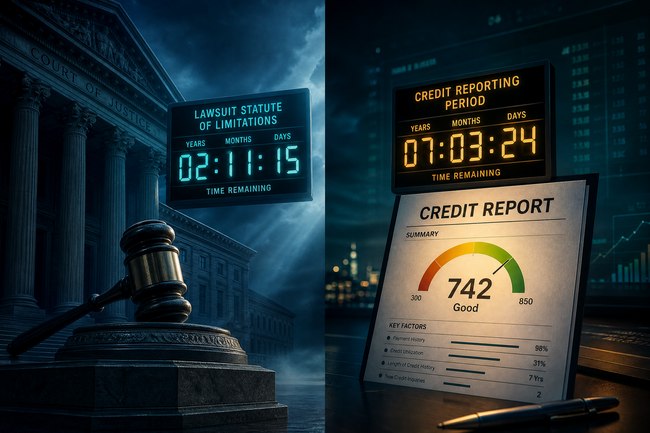
A common source of confusion is the difference between the statute of limitations on debt by state (which governs lawsuits) and the time limits for credit reporting. These are two completely separate legal clocks that run independently of one another.
The statute of limitations on debt by state determines how long a creditor has to sue you in state court. The credit reporting time limit, governed by the federal Fair Credit Reporting Act (FCRA), determines how long negative information can remain on your credit profile [4].
For most derogatory marks—such as late payments, charge-offs, and collections—the information can remain on your credit report generally for up to seven years from the date of the first delinquency that led to the default, subject to applicable reporting rules. This means a debt can be legally time-barred under the statute of limitations on debt by state (if your state has a three-year limit) but still actively damage your credit score for an additional four years. Conversely, in states with ten-year statutes of limitations, a debt might fall off your credit report entirely while you are still legally vulnerable to a lawsuit.
Crucially, while making a partial payment may restart or affect the statute of limitations for a lawsuit in some jurisdictions, it does not restart the seven-year credit reporting clock. credit-reporting timing generally follows the original delinquency date under applicable FCRA rules.
What to Do If You Are Sued for an Expired Debt
Debt collectors frequently file lawsuits on debts that are time-barred under the statute of limitations on debt by state, hoping that the consumer will simply ignore the court summons. If you receive legal paperwork regarding an old debt, you should respond promptly and consider jurisdiction-specific legal guidance.

First, never ignore a court summons. If you fail to respond or do not show up to your hearing, the court may enter a default judgment against you. Once a default judgment is entered, the time-barred status of the debt becomes irrelevant. A judgment creditor may then seek remedies such as wage garnishment, a bank levy, or a property lien where state procedure permits.
Second, the statute of limitations on debt by state is what the legal system calls an “affirmative defense.” The judge will not automatically check the dates and dismiss the case for you. It is entirely your responsibility to file a formal written response to the lawsuit explicitly stating that the debt is time-barred under your state’s laws.
If you are contacted by a collector about an old debt before a lawsuit is filed, you may request information or validation and should avoid making admissions before understanding your rights. You can do this by sending a formal validation request. We have provided a comprehensive resource to help you with this process; the statute of limitations on debt by state can affect lawsuit timing, but it does not replace a validation request. Be sure to utilize our The Ultimate Free Debt Validation Letter Template.
If the debt is indeed valid but you wish to resolve it to clean up your credit or avoid further hassle, you may want to explore settlement options. However, you must negotiate carefully to avoid restarting the clock if the settlement falls through. For strategic advice on this process, read our guide on How to Negotiate a Debt Settlement.
Frequently Asked Questions (FAQ)
Can a debt collector sue you after the statute of limitations expires? Understanding the statute of limitations on debt by state is your first line of defense if a collector contacts you about an old account. Generally, a covered debt collector may not sue or threaten to sue over a time-barred debt under Regulation F, subject to its scope and exceptions. Collection communications may still be permitted in some circumstances, and a separate written request may affect future contact.
Does a time-barred debt disappear? No, the debt does not disappear when the statute of limitations on debt by state expires. You still technically owe the money, and the unpaid account may still appear on your credit report for up to seven years from the date of original delinquency. The expiration may limit the creditor’s ability to obtain a court judgment, but the effect depends on the applicable state law, defenses, and procedural posture.
Will requesting debt validation restart the statute of limitations? No. Exercising your federal right to request debt validation under the FDCPA does not constitute an acknowledgment of the debt and does not ordinarily restart the statute of limitations by itself, but the effect depends on the applicable law and facts.
Which state’s laws apply if I have moved? This can be a complex legal issue, because the statute of limitations on debt by state differs in every jurisdiction. Generally, courts will look at the choice-of-law provision in your original credit agreement, the state where the contract was signed, or the state where you currently reside. Creditors will often attempt to file in the jurisdiction with the longest statute of limitations, but you may have grounds to challenge their choice of venue.
What happens if a creditor gets a judgment against me? If a creditor successfully obtains a court judgment against you—either because the debt was not time-barred or because you failed to raise the statute of limitations as a defense—the original debt transforms into a judgment debt. Judgments have separate limitation periods and renewal rules that vary by jurisdiction; the period and renewal process must be checked under the applicable state law. Judgment rules remain separate from the statute of limitations on debt by state.
Join Our Newsletter
From time to time, we’ll send you information and resources that we believe may be helpful to you.
Subscribe to The Debt Survival Guide Newsletter
Disclaimer: The Debt Survival Guide provides educational content only. We are not attorneys, tax professionals, or financial advisors. This information should not be considered legal, tax, housing, credit, or individualized financial advice. Circumstances, agreements, deadlines, laws, and available options vary by person, account, location, and situation. Please review your records and written terms and consult a qualified attorney, legal-aid organization, HUD-approved housing counselor, tax professional, credit counselor, or financial professional before making decisions about your specific situation.
References
[1] Alper Law. “Statute of Limitations on Debt by State.” https://www.alperlaw.com/asset-protection/statute-of-limitations-on-debt/ [2] Consumer Financial Protection Bureau. “Can debt collectors collect a debt that’s several years old?” https://www.consumerfinance.gov/ask-cfpb/can-debt-collectors-collect-a-debt-thats-several-years-old-en-1423/ [3] Code of Federal Regulations. 12 CFR § 1006.26 – Collection of time-barred debts. [4] Federal Trade Commission. “Fair Credit Reporting Act.” 15 U.S.C. § 1681c.