Mark had a collection letter open beside his grocery list when the caller offered a quick payment to make the pressure stop. He could not remember the last payment—or whether sending money now would change his legal position. The decision felt like a balance between buying time and giving up an option he might still have. Before he reached for his debit card, he needed to know whether an old debt could still lead to a lawsuit.

An old balance can create two different pressures: the demand to pay and the fear of being taken to court. They are not the same issue. Your state’s statute of limitations may restrict a lawsuit, but the answer depends on the account, the relevant dates, and the law that applies. Here is how to sort those questions without assuming that an old debt is either harmless or automatically enforceable.
The Debt Survival Guide is led by Jim Prather, a retired CPA with 45 years of experience. Articles are created with AI assistance through a structured research and writing process. Jim provides editorial direction and performs a high-level structural review, but he does not personally write or line-edit every article. Important legal details should be verified through the cited official sources or a qualified professional.
Quick Answer
Short answer: You may still face a timely lawsuit over an old debt if the applicable statute of limitations has not expired. If it has expired, the debt may be time-barred, and a debt collector covered by federal Regulation F must not sue or threaten to sue to collect it. However, state law, debt type, contract terms, and account history affect the calculation. Some old debts may still be collected without a lawsuit where permitted. Never ignore court papers: you may need to raise the limitations defense yourself, and a default judgment can create a separate enforcement problem.
Table of Contents
Can you still be sued for an old debt?
Possibly. An account’s age alone does not tell you whether a lawsuit is timely. The statute of limitations is the legal deadline for bringing a particular claim, and it depends on the applicable law and the facts of the account.
When that deadline has expired, the debt may be time-barred. Under federal Regulation F, a covered debt collector must not bring or threaten a legal action against a consumer to collect a time-barred debt. The federal debt-collection rules generally do not cover an original creditor collecting its own debt, although state laws may provide additional protections.
Expiration usually limits legal enforcement rather than erasing the account, although some states provide stronger protection. As the CFPB explains in its old-debt guidance, a collector may still request payment where the law permits. If court papers arrive, respond promptly rather than assuming the age of the debt will end the case automatically.
Important caution
Before making a token payment, acknowledging an old balance, or agreeing to a payment plan, check the applicable state’s rules. In some jurisdictions, a payment or acknowledgment can restart a limitations period or revive an otherwise time-barred claim; other jurisdictions restrict revival. The effect can depend on whether the deadline has already expired and whether a promise is written or verbal. If you have been served, protecting the court-response deadline takes priority. Asking a collector for information or negotiating with it does not replace answering the lawsuit.
Why the deadline changes by state and debt type
A single number beside a state name can be misleading. The relevant question is not simply, “How many years does my state allow?” It is, “Which deadline applies to this creditor’s claim against me?”
- Written agreements: Personal loans and other signed contracts may fall under a written-contract statute, a more specific consumer-debt statute, or another rule.
- Oral agreements: A verbal promise may have a different deadline and different proof requirements.
- Promissory notes: A note may be governed by rules for negotiable instruments rather than the general written-contract deadline.
- Credit cards and revolving accounts: Courts do not classify every credit-card claim the same way. Do not automatically assume it uses an “open account” deadline.
The court may also need to consider a contract’s governing-law provision, another state’s law, or a borrowing statute that addresses claims connected to another jurisdiction. Where a lawsuit may be filed and which law governs its deadline are related but distinct questions.
How to check the deadline for your account
Build a short account timeline before trying to calculate an expiration date. The last payment is useful evidence, but it is not always the legal starting point.
- Identify the debt and the claim. Find the original creditor, account type, agreement, and any complaint already filed.
- Gather the dates. Look for missed payments, default notices, acceleration notices, the last payment, and any later payment agreement or written acknowledgment.
- Find the governing rule. Use the official state legislature’s statute website and state judiciary’s consumer-debt resources. Search for the specific debt category, not just a general contract deadline.
- Check what starts the clock. Depending on the claim, the relevant event may be a missed installment, default, acceleration, or another event defined by law.
- Check exceptions and changes. Review tolling, revival, borrowing rules, and whether a statutory amendment applies to an older account.
- If a case exists, compare the relevant lawsuit dates. Filing and service requirements can affect timeliness; the date of the collection letter is not a substitute.
A charge-off date, account-sale date, or credit-report deletion date is not automatically the starting date for a lawsuit deadline. If records conflict or the account involves more than one state, ask a local consumer-law attorney or legal-aid organization to review the timeline. The Legal Services Corporation’s legal-help directory can help you find local assistance.
Payments, promises, and events that can change the clock
Before paying an old account, distinguish between a deadline that has not yet expired and a claim that is already time-barred. State law may treat those situations differently.

Depending on the jurisdiction and the circumstances, a partial payment, written acknowledgment, or new promise to pay may restart a period or revive a claim. Some states limit or prohibit revival for certain consumer debts. A verbal agreement is not automatically harmless, and a written acknowledgment is not automatically effective everywhere.
Other rules can pause the running of a deadline rather than restart it. This is called tolling, and its availability depends on the relevant law and facts. Bankruptcy proceedings and other legally specified events can affect the calculation.
Do not send a small “good faith” payment just to end a call before understanding the consequences. Also do not assume that a collector buying the account gives it a fresh deadline: a sale or transfer does not, by itself, restart the limitations period.
Keep the facts separate
There is no single reliable deadline for every debt in a particular state. Courts may treat credit cards, installment loans, written agreements, and promissory notes differently, and a contract involving another state can complicate the analysis. The lawsuit deadline is also separate from the credit-reporting deadline: an account can disappear from a credit report while a lawsuit remains possible, or remain on a report after it becomes time-barred. Federal student loans and existing judgments require a separate review because their collection rules differ from ordinary consumer-debt lawsuit deadlines.
Ask for verification without making a new payment promise
Before deciding whether to pay, ask who owns the debt, what amount is claimed, and what account records support it. A focused request can avoid mixing an information request with an admission or repayment offer.
Possible wording is: “I dispute this debt and request verification. Please identify the original creditor and provide available records supporting the balance and relevant account dates. I am not acknowledging liability or promising payment.” No sample wording guarantees a particular result under every state’s law.
For covered collectors, a written dispute submitted within the validation period—generally 30 days after receiving the validation notice—requires the collector to stop collection of the disputed debt until it sends verification. A timely written request for original-creditor information has a related protection. See the CFPB’s Regulation F dispute provisions. Federal verification requirements do not necessarily entitle you to every document you request.
Use our debt validation letter template as a starting point, follow the notice’s instructions, and retain proof of submission. If repeated calls are the immediate problem, our guide to stopping debt collectors from calling explains communication options. Limiting calls does not resolve a lawsuit or extend a court deadline.
The lawsuit clock and credit-reporting clock are different
A debt can be too old for a lawsuit yet still appear on a credit report. It can also disappear from a credit report while a timely lawsuit remains possible. Neither status proves the other.
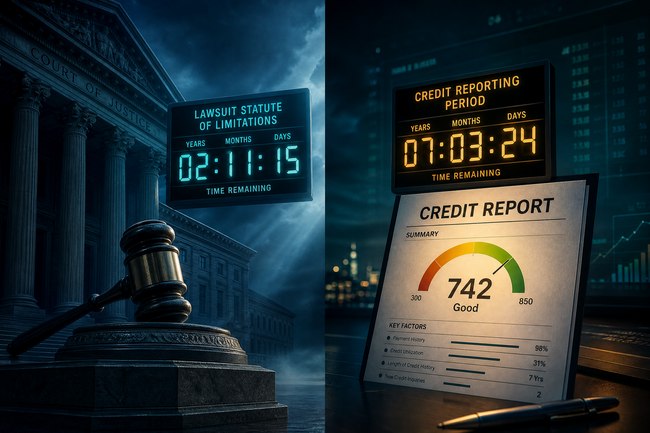
The countdown numbers in this illustration are examples, not deadlines for your account. State law governs many consumer-debt lawsuit deadlines; federal credit-reporting law governs how long much negative account information may be reported.
Under the Fair Credit Reporting Act, most negative information is generally subject to a seven-year reporting limit. For collection accounts and charge-offs, the statutory seven-year period begins 180 days after the delinquency that immediately preceded collection or charge-off. That produces a general outside limit of roughly seven years plus 180 days from that delinquency, subject to applicable exceptions.
A later payment or sale of the account does not create a new original delinquency date for that reporting limit. Payment may change the reported balance or status, but it does not guarantee removal. If the dates or account details are inaccurate, address that as a credit-reporting dispute rather than assuming the lawsuit deadline fixes the report.
If you are served, protect the court deadline first
Do not ignore a summons because the balance appears too old. In many courts, the statute of limitations is an affirmative defense that you must raise under the court’s procedures. Do not rely on the judge to identify it for you.

A limitations defense is not an automatic shield. It needs to fit the account’s facts and be presented correctly.
- Read every page of the summons and complaint. Identify the court, case number, response deadline, and hearing dates.
- Verify the case through the court using its official contact information, particularly if you suspect a collection scam.
- Seek local legal help promptly. Bring the complaint, agreement, payment records, and collection correspondence.
- Follow the court’s response procedures. If supported, raise the limitations defense in the manner required locally and address other allegations as appropriate.
- Keep filing and service records, and attend required hearings. A conversation with the collector does not replace a court filing.
Our guide on how to answer a summons for debt collection explains the practical response process. Local forms and court rules control.
If you miss the deadline, the court may enter a default judgment. State law may then permit collection measures such as garnishment, a bank levy, or a lien, subject to exemptions and procedural protections. A judgment does not make every possible challenge disappear, but setting one aside requires a separate analysis and may involve short deadlines.
Student loans, judgments, and secured debts need a separate review
Do not apply an ordinary credit-card deadline to every obligation. Federal student loans generally do not have a statute of limitations for collection under federal student-loan law. Private student loans may be subject to state-law deadlines, depending on the claim and agreement.
An existing court judgment has its own enforcement and renewal rules. The original account’s lawsuit deadline does not tell you how long the judgment can be enforced or whether it can be renewed.
Secured debts add another distinction: a lawsuit for money and enforcement against collateral may have different rules. If the debt involves a home, vehicle, or other pledged property, obtain advice specific to that obligation rather than treating a general contract deadline as protection against foreclosure or repossession.
Should you pay or settle a time-barred debt?
That is a separate decision from whether a collector can sue. Consider whether the debt is yours, whether the balance is accurate, what state law permits, whether payment could affect the deadline, and whether you can afford the proposed arrangement.
Before sending money, get any settlement terms in writing. The agreement should clearly identify the account, the amount required, the payment deadline, and how the remaining balance will be treated. Do not rely on a verbal promise that payment will remove an account from your credit reports.
If you decide to explore an agreement, our guide on how to negotiate a debt settlement explains preparation and documentation. Review revival rules before making an offer or signing a plan, especially if a failed arrangement could leave you in a worse legal position. The FTC’s Debt Collection FAQs also explains why consumers should check the consequences of paying old debt.
Choose your next step based on what you received
- Court papers: Protect the response deadline and get help evaluating defenses. Do not wait for the collector to answer a records request.
- A collection notice but no lawsuit: Review the validation deadline, request verification as appropriate, and check the account timeline before making a payment promise.
- A credit-report entry: Check ownership, balance, and delinquency dates. Reporting accuracy and lawsuit timeliness require separate reviews.
- A demand based on an existing judgment: Obtain the judgment and review enforcement, renewal, exemptions, and any available challenge under local law.
The safest starting point is not “This debt is old, so I can ignore it.” It is “What kind of debt is this, which law applies, and what deadline do I need to protect today?”
Frequently Asked Questions
How do I find the statute of limitations for debt in my state?
Start with your state legislature’s official statute website and state court consumer-debt resources. Identify the debt category, the event that starts the period, and any consumer-credit-specific provisions. Check revival, tolling, and rules for claims connected to another state. A general chart is not enough to determine whether a particular lawsuit is timely.
Can a collector still contact me about time-barred debt?
In some jurisdictions, a collector may request voluntary payment even when a lawsuit is time-barred. State law can provide stronger restrictions, and federal rules still limit covered collectors’ conduct. Regulation F prohibits covered collectors from suing or threatening to sue to collect time-barred debt. A request to stop contact does not erase the account or resolve existing court proceedings.
Will making a small payment restart the statute of limitations?
It can in some jurisdictions, but not everywhere. The effect depends on the debt, applicable law, and whether the limitations period has already expired. Some states restrict revival of consumer debts. Check the rule before making a token payment, acknowledging the balance, or agreeing to a new payment plan.
Does selling a debt to a collection agency give it a new deadline?
A sale or transfer does not, by itself, restart the statute of limitations. The account’s underlying history remains relevant, although later payments, promises, or other legally significant events may affect the calculation. A sale also does not create a new original delinquency date for the federal credit-reporting limit.
Will requesting debt validation restart the clock?
A request that only disputes the debt or asks for verification ordinarily does not, by itself, amount to a payment or promise to pay. However, wording and state law matter. Avoid adding an admission, repayment commitment, or payment to the request before understanding the rules. A validation request does not replace a response to a court summons.
Which state’s law applies if I have moved?
There is no universal answer. The court may consider the forum’s rules, the account’s connection to another state, a contract’s governing-law provision, and any borrowing statute. Moving can also raise questions about tolling and proper venue. Neither your current address nor the creditor’s location automatically determines the applicable deadline; interstate accounts are a good reason to seek local legal advice.
What to Do Next
First, check whether you have actual court papers and identify any response or hearing deadline. Then gather the agreement, payment history, collection notices, and dates of missed payments or default. Ask the collector for verification without adding a promise to pay, and keep copies of everything you send. Use official state statutes and court resources to identify the rule for your debt category, including any revival or tolling provisions. If a lawsuit, interstate issue, student loan, or judgment is involved, seek local legal help before relying on a date calculation.
Disclaimer: The Debt Survival Guide provides educational content only. We are not attorneys, tax professionals, or financial advisors. This information should not be considered legal, tax, housing, credit, or individualized financial advice. Circumstances, agreements, deadlines, laws, and available options vary by person, account, location, and situation. The time limits for filing suit and the effect of a payment or acknowledgment can vary by jurisdiction and debt type. Please review your records and written terms and consult a qualified attorney, legal-aid organization, HUD-approved housing counselor, tax professional, credit counselor, or financial professional before making decisions about your specific situation.
References and Sources
- Federal Trade Commission — Debt Collection FAQs: Official source — Debt-collection rights, time-barred debt, the importance of responding to lawsuits, validation protections, and the potential consequences of paying or acknowledging old debt.
- Consumer Financial Protection Bureau — Can debt collectors collect a debt that’s several years old?: Official source — Limitations depend on state law, debt type, and applicable contract law; some old debts may still be collected without suit; payment or acknowledgment may affect a limitations period.
- Consumer Financial Protection Bureau — Regulation F, 12 CFR § 1006.26: Official source — The definition of time-barred debt and the prohibition on covered debt collectors bringing or threatening legal action against consumers to collect time-barred debt.
- Consumer Financial Protection Bureau — Regulation F, 12 CFR § 1006.38: Official source — Covered collectors’ duties following timely written disputes and requests for original-creditor information during the validation period.
- U.S. Code — 15 USC § 1681c, Fair Credit Reporting Act: Official source — Federal limits on reporting negative information and the delinquency-based calculation for collection accounts and charge-offs, including the 180-day provision and statutory exceptions.
- U.S. Code — 20 USC § 1091a, Statute of limitations and State court judgments: Official source — Federal student-loan collection is subject to special federal rules removing limitation periods for covered obligations, rather than ordinary state consumer-debt deadlines.
- Legal Services Corporation — I Need Legal Help: Official source — A practical directory for finding local civil legal-aid organizations; eligibility and available assistance depend on the provider and circumstances.