When Raymond sat down with his credit card statements and a spreadsheet, he thought he could figure out his payoff timeline on his own. After two hours of confusing formulas and contradictory results, he was more frustrated than when he started. His four credit cards carried different interest rates, different balances, and different minimum payments, and the math was overwhelming. Then a friend suggested he try a debt payoff calculator, and within ten minutes he had a clear month-by-month plan showing exactly when each card would reach zero. The debt payoff calculator transformed his vague hope of becoming debt-free into a concrete timeline with specific milestones he could track every single month.

At The Debt Survival Guide, our team draws on over 45 years of CPA experience to help you understand how to use a debt payoff calculator effectively. These free online tools eliminate the complex math of compound interest, varying payment amounts, and multiple accounts, giving you an instant visual roadmap to becoming debt-free. A debt payoff calculator does in seconds what would take hours to compute manually, and the clarity it provides can be the difference between staying motivated and giving up on your payoff journey.
Table of Contents
What a Debt Payoff Calculator Actually Does
A debt payoff calculator takes your current balances, interest rates, and monthly payment amounts, then projects exactly how long it will take to eliminate each debt completely. The tool accounts for compound interest, which is the mathematical reality that makes credit card debt so difficult to escape through minimum payments alone. Every month, interest accrues on your remaining balance, and the debt payoff calculator shows you using the stated assumptions how much of each payment goes toward interest versus principal reduction.
The Consumer Financial Protection Bureau recommends that consumers use financial planning tools to understand their debt obligations before making repayment decisions. A debt payoff calculator serves this purpose perfectly by converting abstract numbers into a concrete timeline. Instead of wondering whether you will be debt-free in three years or thirteen years, the calculator gives you an an estimated payoff period that can change with balances, APRs, fees, payment rules, and new charges based on your current payment behavior. This precision eliminates the anxiety of uncertainty and replaces it with a clear path forward that you can follow step by step. The psychological benefit of knowing your exact timeline cannot be overstated because it transforms an overwhelming problem into a manageable project with a definite end date.
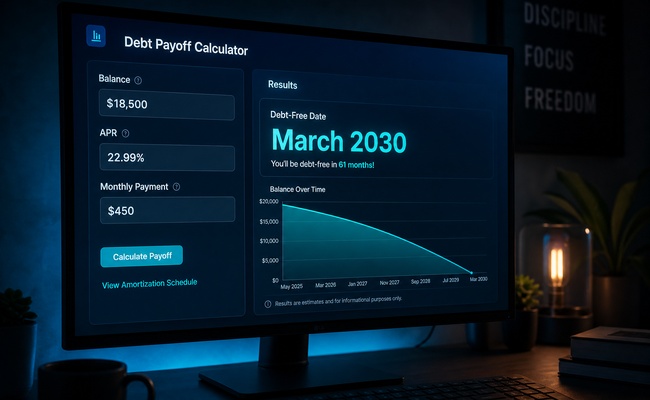
When you know that your last payment will be in March of a specific year, you can plan celebrations, set new financial goals, and maintain hope during the difficult months in between. This concrete endpoint is what separates people who successfully eliminate their debt from those who make payments indefinitely without ever seeing the finish line. Having a specific date to count down to makes the daily sacrifices along the way feel purposeful rather than endless and overwhelming.
Most debt payoff calculator tools also allow you to experiment with different scenarios. You can see what happens if you add an extra $50 per month, what changes if you get a lower interest rate, or how much faster you would be debt-free if you applied your tax refund to the balance. This scenario-testing capability makes the debt payoff calculator not just an information tool but a strategic planning instrument that helps you make informed decisions about where to direct every available dollar.
Try this free credit card payoff calculator from Bankrate to see your exact debt-free date.
The Information You Need Before Starting
Before opening a debt payoff calculator, gather your most recent statements for every debt you want to include. You need three pieces of information for each account: the current balance, the annual percentage rate, and your current monthly payment. Having exact numbers rather than estimates produces accurate projections that you can actually rely on for planning purposes. Do not guess or round your numbers because even small inaccuracies compound over a multi-year timeline and can make your projections unreliable. Take fifteen minutes to log into each account online and write down the exact figures rather than relying on memory or estimates from months ago.

For credit cards, find your APR on your statement or in your online account under account details. Many people are surprised to discover their actual rate because they never looked closely at it before using a debt payoff calculator. If you have multiple cards, list each one separately because the different rates dramatically affect which debt costs you the most over time. Understanding these rates is the foundation of every effective payoff strategy. Many people discover that one card is costing them significantly more than the others simply because its rate is five or ten percentage points higher, which immediately clarifies where extra payments should be directed first.
Include all revolving debts in your debt payoff calculator analysis: credit cards, personal loans, medical debt on payment plans, and any other obligations with interest charges. The more complete your picture, the more accurate your timeline will be. Some people exclude small debts thinking they do not matter, but even a $500 balance at 24% interest adds up significantly over time and affects your total payoff date. If you are working with a realistic debt repayment budget, the calculator shows you exactly how your budgeted payments translate into a debt-free date.
The shocking payoff timelines your calculator reveals are not a glitch — they are the result of a deliberately designed system. Our guide on the credit card minimum payment trap explains exactly why minimum payments are set so low and how credit card companies profit from keeping you in debt for decades.
Choosing Between Snowball and Avalanche Methods
Every quality debt payoff calculator lets you compare two primary repayment strategies: the debt snowball method and the debt avalanche method. The snowball method targets your smallest balance first regardless of interest rate, giving you quick psychological wins as accounts reach zero. The avalanche method targets your highest interest rate first regardless of balance size, saving you the most money mathematically over the life of your repayment plan.

When you enter your debts into a debt payoff calculator and toggle between these methods, the difference in total interest paid often surprises people. On $30,000 of credit card debt spread across four cards, the avalanche method typically saves $800 to $2,000 in total interest compared to the snowball method. However, the snowball method eliminates your first account months earlier, which provides motivation that keeps many people on track. The best strategy is the one you will actually stick with, and the calculator helps you see both options clearly before committing. Our detailed comparison of the debt snowball versus debt avalanche method explains the psychology behind each approach.
Some advanced debt payoff calculator tools offer a hybrid approach where you start with the snowball method to build momentum by eliminating one or two small accounts, then switch to the avalanche method for the remaining larger balances. This combines the motivational benefit of early wins with the mathematical efficiency of targeting high-interest debt, giving you the best of both worlds. Run both scenarios in your debt payoff calculator to see which timeline resonates more with your personal motivation style.
Reading Your Results: What the Numbers Mean
After entering your information, a debt payoff calculator produces several key outputs that deserve careful attention. The most important number is your debt-free date, which tells you exactly when your last payment will bring your balance to zero. For many people, seeing a specific date rather than an abstract concept of someday creates a powerful psychological shift that transforms debt repayment from a burden into a countdown.
The total interest paid figure shows you exactly how much your debt is costing you beyond the original purchases. This number is often shocking. A $15,000 credit card balance at 22% interest with minimum payments will cost you over $14,000 in interest alone, meaning you pay nearly double what you originally charged. Seeing this number motivates many people to increase their monthly payments immediately because the cost of inaction becomes viscerally real. The total interest figure is essentially the price you pay for the privilege of carrying debt over time, and most people are stunned when they realize how much that privilege actually costs them.

Pay attention to the monthly amortization schedule that most debt payoff calculator tools provide. This month-by-month breakdown shows your balance declining over time, the interest portion shrinking as principal decreases, and specific milestone dates when individual accounts reach zero. Print this schedule and post it somewhere visible. Watching your actual progress match the projected timeline reinforces your commitment and proves that the math works in your favor when you stay consistent. Many successful debt eliminators report that seeing their balance decrease exactly as predicted each month was the single most motivating factor in their journey to becoming debt-free.
If your calculator results show that even aggressive payments will take years, consolidation might compress that timeline significantly. Our guide on how long debt consolidation takes walks through every phase from application to final payoff so you can compare the consolidated timeline against your current trajectory.
The Extra Payment Experiment
The most powerful feature of any debt payoff calculator is the ability to model extra payments. Even small additional amounts produce dramatic results over time because they go entirely toward principal reduction, which then reduces future interest charges in a compounding cascade. The Federal Trade Commission emphasizes that paying more than the minimum is the a strategy that may fit some consumers but requires individualized comparison for escaping credit card debt faster.

Try entering different extra payment amounts into your debt payoff calculator to see the impact. On a $20,000 balance at 20% interest, adding just $100 per month to your payment cuts your payoff time from over 30 years with minimums to approximately 5 years. That single $100 monthly increase saves you over $25,000 in total interest. The debt payoff calculator makes this invisible math visible, showing you that relatively small sacrifices today produce enormous financial benefits over your repayment timeline.
Consider running your debt payoff calculator with irregular extra payments as well. Many people receive annual bonuses, tax refunds, or occasional windfalls that could accelerate their payoff. Enter a lump sum payment of $2,000 or $3,000 at specific points in your timeline to see how these one-time contributions affect your debt-free date. Often a single large payment applied to your highest-rate card can shave months off your total timeline because it eliminates a chunk of principal that would have generated interest charges for years to come. Understanding how the minimum payment trap works makes these extra payment calculations even more compelling.
Common Mistakes When Using a Calculator
The most frequent error people make with a debt payoff calculator is entering their minimum payment as a fixed amount when it actually decreases as their balance drops. Credit card minimum payments are typically calculated as a percentage of your balance, usually 1% to 3% plus interest. As your balance decreases, your minimum payment shrinks, which extends your payoff timeline dramatically. Always enter the payment amount you plan to make consistently, not the current minimum that will decrease over time. If your current minimum is $350, lock that amount in as your fixed payment even as the required minimum drops to $200 or $150 over time. This approach alone can cut years off your payoff timeline.
Another mistake is forgetting to account for continued spending on the cards you are trying to pay off. A debt payoff calculator assumes you are not adding new charges to your balances. If you continue using a card while trying to pay it down, your actual payoff date will be significantly later than what the calculator projects. The most effective approach is to stop using cards entirely while executing your payoff plan, relying on cash or a debit card for daily expenses. Put your cards in a drawer, freeze them in a block of ice, or give them to a trusted friend. Whatever method prevents you from adding new charges will keep your projections accurate and your timeline on track.

The discipline of not adding new debt while paying off existing balances is the single most important behavioral change you can make during your repayment journey. Without this commitment, even the most sophisticated repayment strategy will fail because new charges constantly push your debt-free date further into the future.
People also make the error of running their debt payoff calculator once and never revisiting it. Your financial situation changes over time. Interest rates may increase, you might receive a raise that allows larger payments, or unexpected expenses might temporarily reduce what you can contribute. Revisit your debt payoff calculator every three months to update your numbers and adjust your timeline based on current reality rather than outdated projections. Treat it as a quarterly financial checkup that keeps you honest about your progress and helps you celebrate how far you have come since your last review.
Turning Calculator Results Into Action
A debt payoff calculator is only valuable if you translate its projections into actual behavior changes. After running your numbers, set up automatic payments for the amount shown in your optimal scenario. Automation removes the temptation to pay less during months when motivation is low and helps support consistent progress toward your debt-free date regardless of how you feel on any given day. Schedule your automatic payment for the day after your paycheck deposits so the money goes toward debt before you have a chance to spend it on something else. This pay-yourself-first approach ensures your repayment plan stays on track month after month without requiring willpower or conscious decision-making.
The beauty of automation is that it works even on your worst days, your busiest weeks, and your most distracted months. Once set up, your repayment plan does not execute without monitoring account, cash-flow, rate, fee, posting, and balance changes without any ongoing effort from you. This is the closest thing to a reliable set-it-and-forget-it solution that exists in personal debt management today.
Create monthly checkpoints based on your debt payoff calculator projections. If the calculator shows your first card reaching zero in month eight, mark that date on your calendar and track your progress against it. When you hit that milestone on schedule, the sense of accomplishment fuels your motivation for the remaining accounts. The Fair Debt Collection Practices Act protects you from harassment during your repayment journey, but the goal of using a debt payoff calculator is to stay ahead of your obligations so collections never become an issue.

Share your debt payoff calculator results with an accountability partner. Whether it is a spouse, friend, or financial counselor, having someone who knows your timeline and checks in on your progress significantly increases the likelihood of following through. The numbers from your debt payoff calculator become a shared commitment rather than a private hope, and the social accountability helps you maintain discipline during the months when progress feels slow. Research consistently shows that people who share their financial goals with at least one other person are significantly more likely to achieve them than those who keep their plans private.
Finally, celebrate the milestones your debt payoff calculator identified. When you eliminate your first account, when you cross the halfway point on total debt, and when you make your final payment, acknowledge these achievements. The journey from overwhelmed to debt-free is long, and the debt payoff calculator gives you specific points along the way where celebration is earned and motivation is renewed. Plan small rewards for each milestone that do not involve spending money you do not have. A special dinner at home, a day off from worrying about finances, or simply acknowledging your discipline to someone you trust can reinforce the positive behavior that got you to that point.
The journey to becoming debt-free is a marathon, not a sprint, and sustainable motivation requires regular recognition of progress along the way. Every milestone you reach proves that the math works and that your commitment is producing real results. Use each success as fuel for the next phase of your repayment journey, knowing that every payment brings you closer to financial freedom.
Frequently Asked Questions
Are free debt payoff calculators accurate?
Yes, reputable free calculators from financial education sites use the same compound interest formulas as paid tools. The accuracy depends entirely on the information you enter. If your balance, rate, and payment amounts are correct, the projections will be mathematically precise. A debt payoff calculator is only as good as the data you provide.
Should I include my mortgage in the calculator?
Generally no, unless you are specifically trying to become completely debt-free including your home. Most people use a debt payoff calculator for consumer debt like credit cards, personal loans, and medical bills. Mortgages have much lower interest rates and different tax implications that make them a separate planning category.
How often should I update my calculator inputs?
Every three months or whenever a significant change occurs, such as a rate increase, a large extra payment, or a change in your monthly budget. Regular updates keep your debt payoff calculator projections aligned with reality and help you catch any drift from your original plan before it becomes a major setback.
What if my debt payoff calculator shows a timeline longer than I can handle?
A long timeline is a signal to explore options for accelerating your payoff. Consider negotiating lower interest rates, finding additional income sources, or exploring debt consolidation. If the calculator shows more than five years at your current payment level, increasing your monthly contribution by even a small amount can dramatically shorten the timeline.
Can I use a debt payoff calculator for student loans?
Absolutely. Student loans work well in these calculators because they have fixed rates and predictable payment structures. Enter each loan separately if you have multiple student loans with different rates. The debt payoff calculator will show you which loan to target first and how extra payments affect your total repayment cost.
Here Are More Articles That Might Interest You
If your calculator shows high interest eating most of your payments, learn how to negotiate a lower credit card interest rate to accelerate your payoff.
Understanding how credit utilization impacts your score shows why paying down balances improves more than just your debt level.
Our guide on debt consolidation pros and cons explains when combining debts into one payment makes mathematical sense.
Learn about credit card hardship programs that can temporarily reduce your rate while you execute your payoff plan.
Discover how long debt consolidation takes if your calculator results suggest consolidation would help.
If your debt situation feels overwhelming, our guide on what to do first when drowning in debt provides a triage framework.
Learn whether using your 401(k) to pay off debt is worth the penalties and tax consequences.
Our guide on debt management plan pros and cons explains how nonprofit agencies can negotiate lower rates on your behalf.
Find out about how debt settlement affects your credit if your calculator shows a timeline you cannot sustain.
Learn about the tax implications of settled debt before choosing settlement over full repayment.
Join Our Newsletter
From time to time, we’ll send you information and resources that we believe may be helpful to you.
Subscribe to The Debt Survival Guide Newsletter
Disclaimer: The Debt Survival Guide provides educational content only. We are not attorneys, tax professionals, or financial advisors. This information should not be considered legal, tax, housing, credit, or individualized financial advice. Circumstances, agreements, deadlines, laws, and available options vary by person, account, location, and situation. Please review your records and written terms and consult a qualified attorney, legal-aid organization, HUD-approved housing counselor, tax professional, credit counselor, or financial professional before making decisions about your specific situation.