Curtis had done everything right — or so he thought. The 58-year-old machinist from Toledo scraped together $1,840 to pay off an old medical collection, expecting his credit score to bounce back. Three months later, he pulled his credit report and felt his stomach drop. The collection was still there, now marked “paid,” still dragging his score down, still blocking the refinance he needed. Nobody had told Curtis about a pay for delete letter. If he had sent one before paying a single dime, that account might be removed if the collector voluntarily agrees, but no deletion result is guaranteed. This guide gives you the exact pay for delete letter template Curtis wishes he had, plus step-by-step instructions to use it correctly.

At The Debt Survival Guide, our team draws on over 45 years of CPA experience helping people navigate debt collection, credit reporting, and financial recovery. This guide describes common pay-for-delete practices and cautions, but outcomes depend on the collector, furnisher, agreement, bureau, and facts. Everything in this guide reflects that real-world experience, translated into plain English you can act on today.
Table of Contents
What Is a Pay for Delete Letter?
A pay for delete letter is a written offer you send to a collection agency proposing a simple trade: you pay the debt (in full or as a negotiated settlement), and in exchange, the collector agrees to completely remove the collection account from your credit reports at all three bureaus — Equifax, Experian, and TransUnion. Not update it to “paid.” Not mark it “settled.” Delete it entirely, as if it never existed.
This distinction matters more than most people realize. A paid collection can still damage your credit score under older FICO scoring models, and it stays on your report for up to seven years from the date of first delinquency. A deleted collection, by contrast, stops affecting your score the moment it disappears. That is why a pay for delete letter can be worth hundreds of dollars in future interest savings on mortgages, auto loans, and credit cards.
Here is the critical rule: the pay for delete letter must be sent, negotiated, and agreed to in writing before you pay anything. Once you pay, you lose all your leverage. The collector already has your money, and they have zero incentive to do you any favors. Curtis learned that lesson the expensive way.
Before you offer any money to a debt collector, you need to understand how payment impacts your credit score. For a complete strategy, read our comprehensive guide on handling collections on credit report files effectively.
How Pay for Delete Works: The Mechanics
To understand why a pay for delete letter works, you need to know how collections land on your credit report in the first place. Collection agencies are “data furnishers.” They voluntarily report account information to the credit bureaus under a set of industry reporting standards. The key word is voluntarily — reporting and deletion are governed by applicable FCRA furnishing, accuracy, dispute, bureau-policy, and contractual rules.
When a collector accepts your pay for delete letter offer, they simply stop reporting the account or submit a deletion request to the bureaus. Within deletion timing varies and is not guaranteed, the tradeline disappears from your credit file. Your score is then recalculated without that negative item.
Now for the honest caveat you will not find in hype-driven articles: credit bureau furnisher agreements technically discourage deleting accurate information in exchange for payment. That is why many large agencies officially say no. But in practice, smaller collection agencies and junk debt buyers who purchase old zombie debt for pennies on the dollar agree to pay for delete arrangements every day. For them, your payment is pure profit, and deleting one tradeline costs them nothing. The pay for delete letter simply puts that offer in front of them in a form they can accept.
When to Use a Pay for Delete Letter: The Best Situations
A pay for delete letter is not the right tool for every debt. It works best in specific situations, and knowing when to deploy it dramatically improves your odds.
The ideal scenario is a debt owned by a third-party collection agency or debt buyer — not your original creditor. Original creditors like major banks almost never delete accurate tradelines, while debt buyers who may have acquired the account at a price that varies widely have every reason to take your money and delete. The debt should also be legitimately yours and within the statute of limitations considerations you can verify using our state-by-state statute of limitations guide.
Before sending any pay for delete letter, validate the debt first. If a collector cannot prove the debt is yours, you may not owe anything at all — and you should never pay a debt that cannot be validated. Our free debt validation letter template walks you through that process step by step. Validation also confirms the exact balance and the collector’s legal authority to collect, both of which strengthen your negotiating position.
The table below summarizes when a pay for delete letter is likely to succeed and when a different strategy fits better.
| Situation | Send a Pay for Delete Letter? | Better Alternative |
|---|---|---|
| Debt owned by a small collection agency or debt buyer | Yes — may be worth considering, but no success rate is guaranteed | — |
| Debt still with the original creditor | Rarely works | Goodwill letter after paying |
| Debt you do not recognize | No — validate first | Debt validation letter |
| Debt past the statute of limitations | Use extreme caution | Know your state’s rules first |
| Medical collection under $500 | Not needed | Reporting depends on current bureau policies and applicable thresholds |
| Very old collection (6+ years) | Usually not worth paying | Wait for it to age off |
One more timing note: medical collections under $500 no longer appear on credit reports at all under current bureau policies, and paid medical collections of any size are removed automatically. If your collection is medical, check whether it qualifies for removal before you offer anyone money.

The Free Pay for Delete Letter Template
Here is the free pay for delete letter template you came for. Copy it, customize the bracketed fields, and keep the tone exactly as written — polite, businesslike, and legally careful. Notice that the template never admits the debt is yours and frames payment as consideration for deletion, not an acknowledgment of liability.
[Your Name]
[Your Address]
[City, State, ZIP]
[Date][Collection Agency Name]
[Agency Address]
[City, State, ZIP]Re: Account Number [Account Number as shown on your credit report or collection notice]
To Whom It May Concern:
This letter is in reference to the above account, which your agency claims I owe in the amount of $[Amount]. This letter is not an acknowledgment or acceptance of this debt, and it is not a promise to pay. It is a settlement offer made for the purpose of resolving this matter.
I am willing to pay $[Offer Amount] as full and final settlement of this account. In exchange, [Collection Agency Name] agrees to delete all references to this account from my credit files at Equifax, Experian, and TransUnion, and to cease all collection activity on this account.
If you accept these terms, please send written confirmation on your company letterhead, signed by an authorized representative, stating that you agree to the terms above. Upon receipt of your signed agreement, I will remit payment of $[Offer Amount] within [10] business days via [money order / cashier’s check].
This offer expires 30 days from the date of this letter. Please note that I am aware of my rights under the Fair Debt Collection Practices Act and the Fair Credit Reporting Act. This letter and your response may be used as documentation of our agreement.
Sincerely,
[Your Name — typed, not signed]
Why no signature? Some consumer attorneys recommend typing rather than signing your name on collection correspondence to prevent any possibility of signature misuse. Whether a typed name is sufficient depends on the agreement, recipient, applicable law, and required signature formalities.
How to Customize the Template: Step by Step
A generic letter gets generic results. Follow these steps to tailor the pay for delete letter template to your specific account, and you will sound like someone who knows their rights — because you will be.
Step 1: Pull all three credit reports. Get free copies at AnnualCreditReport.com, the only federally authorized source. Note exactly how the collection appears on each bureau’s report, including the account number and reported balance.
Step 2: Fill in the account details precisely. Use the account number from the collection notice or credit report entry. If the numbers differ between bureaus, list the version from the collector’s own letter. Accuracy here prevents the agency from claiming they could not locate your account.
Step 3: Choose your offer amount. Debt buyers typically purchase accounts for 4 to 10 cents on the dollar, so there is real room to negotiate. Starting at 30 to 50 percent of the balance is reasonable for older debts; newer collections may require 60 to 100 percent. Our guide on how to negotiate a debt settlement covers offer strategy in detail, and the same percentages apply when you attach a deletion condition.
Step 4: Set the payment method. Specify a money order or cashier’s check. Never give a collection agency direct access to your bank account — as we explain in our article on whether debt collectors can take money from your bank account, protecting your account information is basic self-defense.
Step 5: Keep the deadline. The 30-day expiration creates urgency and signals that you are organized. Collectors respond faster to offers with expiration dates.
How to Send Your Pay for Delete Letter the Right Way
Delivery method matters as much as the letter itself. Send every pay for delete letter by certified mail with return receipt requested through the U.S. Postal Service. The green return-receipt card (or electronic equivalent) proves the agency received your offer on a specific date, which becomes critical evidence if they later accept payment but fail to delete.

Keep a complete paper trail: a copy of the letter, the certified mail receipt, the return receipt, and any written response. Store them together with your credit report printouts showing the account before deletion. If the agency agrees, you will add their signed acceptance letter and your payment proof to the same folder.
Never negotiate a pay for delete by phone alone. Collectors’ verbal promises are notoriously unreliable, and phone agreements are nearly impossible to enforce. If a representative agrees to deletion terms on a call, respond with: “Great — please send that agreement in writing on company letterhead, and I will pay within ten business days of receiving it.” A legitimate agreement survives being put in writing. A trick does not.

What to Do If the Collector Says No
Some agencies will refuse your pay for delete letter, often citing their agreements with the credit bureaus. Do not panic, and do not immediately pay the full balance out of frustration. You still have several moves.
First, raise your offer or ask to speak with a supervisor. Frontline collectors often lack authority to approve deletions; managers frequently have more flexibility, especially near month-end quotas. Second, wait 60 to 90 days and try again — accounts get reassigned, policies shift, and a new representative may see your pay for delete letter differently.
Third, if the pay for delete letter is rejected outright, negotiate the best settlement you can without deletion, but insist the account be reported as “paid in full” or “settled” with a zero balance. Under newer scoring models like FICO 9, FICO 10, and VantageScore 3.0 and 4.0, paid collections are ignored entirely, so paying still helps with many lenders even without deletion.
Fourth, after paying, send a goodwill letter asking the agency to delete the account as a gesture of goodwill (more on that below). Finally, if the collector has violated your rights at any point — harassing calls, false threats, misrepresenting the debt — document everything using our guide to spotting FDCPA violations. Violations create legal leverage that can turn a “no” into a “yes,” and you can file a complaint with the Consumer Financial Protection Bureau.
After They Agree: Verify Removal on All 3 Bureaus
Getting a signed pay for delete agreement is the halfway point, not the finish line. Follow this sequence to make sure the deletion actually happens.
Pay exactly as agreed, using the method stated in the agreement, and keep proof of payment — the money order stub or cashier’s check copy plus the certified mail receipt if you mail it. Then mark your calendar for 45 days out. Most agencies process deletions within deletion timing varies and is not guaranteed of payment clearing.
At the 45-day mark, pull all three credit reports again from AnnualCreditReport.com — free weekly access may be available under current reporting rules; verify current availability to your Equifax, Experian, and TransUnion reports. Confirm the account is gone from each bureau, not just one. Deletion or updating can be delayed or inconsistent, and each bureau maintains its own file; verify all three.

If the account still appears after 60 days, send the agency a follow-up letter enclosing a copy of the signed agreement and demanding compliance. If that fails, dispute the account directly with each bureau, attaching the agreement as proof. Under the Fair Credit Reporting Act, bureaus must investigate disputes, and a furnisher’s written promise to delete is powerful evidence. A collector who takes your money and breaks a written deletion agreement may also face liability for deceptive practices — another reason the paper trail matters.
Pay for Delete vs. Goodwill Letter: The Difference
People often confuse these two tools, but they work at opposite ends of the timeline. A pay for delete letter is a negotiation before payment: deletion is the condition of your money. A goodwill letter is a request after payment: the debt is already paid, and you are asking the furnisher to delete the account as an act of grace, usually citing hardship circumstances like job loss, medical crisis, or divorce.
Because a goodwill letter carries no leverage, success rates are lower — but not zero, and it costs only a stamp. It is the right tool when you already paid (like Curtis), when the account is with an original creditor who will not negotiate deletions, or when the negative item is a late payment rather than a collection. The comparison below shows where each pay for delete letter alternative fits.
| Factor | Pay for Delete Letter | Goodwill Letter |
|---|---|---|
| Timing | Before you pay | After you pay |
| Leverage | Your payment | None — appeals to goodwill |
| Best target | Debt buyers, collection agencies | Original creditors |
| Works on | Collections | Late payments, paid collections |
| Success rate.*Variable; no outcome guaranteed | Low but nonzero | |
| Cost if it fails | Nothing — do not pay without agreement | Nothing |
If your negative item is a charge-off still held by the original creditor rather than a collection, the strategy differs again — our article on charge-off vs. collection explains how to tell which one you are dealing with and why it changes your approach.
Does Pay for Delete Still Work in 2026?
Yes — a pay for delete letter still works in 2026, but with clear-eyed expectations. The strategy has never been a guaranteed magic eraser, and anyone who promises otherwise is selling something. Here is the realistic landscape this year.
Success remains highest with smaller collection agencies and debt buyers handling older accounts, where a deletion costs the company nothing and your payment is nearly pure profit. Large national agencies refuse more often, citing bureau furnisher agreements. Original creditors almost always refuse. Roughly speaking, your odds improve the further the debt has traveled from the original lender and the smaller the company currently holding it.
Two industry changes actually work in your favor. First, newer credit scoring models ignore paid collections entirely, so even a failed pay for delete letter negotiation that ends in a paid-in-full settlement still helps your score with lenders using FICO 9 or VantageScore 4.0. Second, medical collections under $500 and all paid medical collections have been removed from credit reports industry-wide, shrinking the problem for millions of consumers before a single letter is sent.
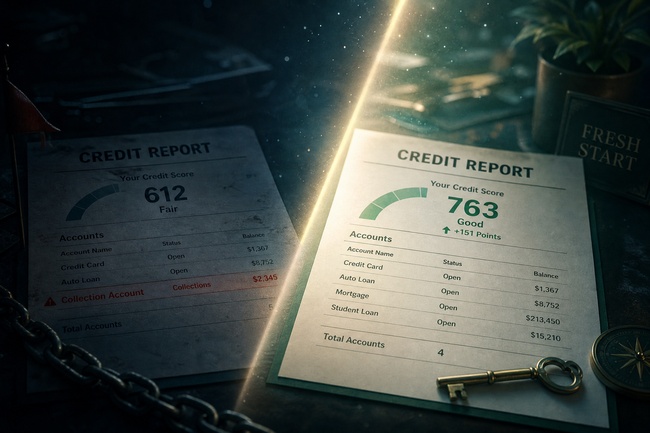
The bottom line: a pay for delete letter costs you a stamp and fifteen minutes. When it works, it can lift your credit score significantly — often 20 to 80 points depending on your file — and when it fails, you have lost nothing and can pivot to settlement or goodwill strategies. Few tools in credit repair offer that risk-reward ratio. Whatever you do, never ignore the collection entirely; as we cover in what happens if you ignore a debt collector, silence usually makes things worse.
Pay for Delete Letter FAQ
Do I need a lawyer to send a pay for delete letter?
No. A pay for delete letter is a simple settlement offer any consumer can write and send. The free template above covers the protective language you need. A consumer attorney becomes worthwhile only if the collector sues you or repeatedly violates your rights.
Is a pay for delete letter legal?
Yes. Sending a pay for delete letter is completely legal — you are simply making a settlement offer with conditions. Collectors’ agreements with credit bureaus discourage deletion of accurate information, which is a contractual matter between the collector and the bureaus, not a law that binds you. Asking is generally a settlement proposal, but no outcome or legal consequence can be guaranteed.
How much should I offer in a pay for delete letter?
Start between 30 and 50 percent of the balance for older debts owned by debt buyers, and expect to land between 50 and 100 percent. Some agencies only accept pay for delete at full balance. Any discount you negotiate is a bonus on top of the deletion itself.
Will a pay for delete letter restart the statute of limitations?
The letter template above is worded to avoid acknowledging the debt, which protects you. However, actually making a payment can restart the statute of limitations on old debt in some states. If your debt is near or past the limitations period, read our statute of limitations guide before offering anything.
How long does pay for delete take to remove a collection?
Most deletions appear within deletion timing varies and is not guaranteed after your payment clears. Check all three bureaus at the 45-day mark and follow up in writing if the account remains after 60 days.

Can I use a pay for delete letter with the original creditor?
You can send one, but original creditors rarely agree because they report large volumes of data under strict bureau agreements. For original-creditor accounts, pay the debt and follow up with a goodwill letter instead.
Does a pay for delete letter hurt my credit?
No. Sending the letter generally does not itself change a credit report or score, but the outcome depends on the collector, furnisher, bureau, and reporting facts. Any credit change depends on what is reported, corrected, updated, or deleted and how the applicable scoring model treats it.
What if the collector deletes from only one bureau?
Partial deletion violates your agreement if the letter specified all three bureaus — and the template above does. Send a written demand citing the signed agreement, then dispute with the remaining bureaus and attach the agreement as evidence.

Join Our Newsletter
From time to time, we’ll send you information and resources that we believe may be helpful to you.
Subscribe to The Debt Survival Guide Newsletter
Disclaimer: The Debt Survival Guide provides educational content only. We are not attorneys, tax professionals, or financial advisors. This information should not be considered legal, tax, housing, credit, or individualized financial advice. Circumstances, agreements, deadlines, laws, and available options vary by person, account, location, and situation. Please review your records and written terms and consult a qualified attorney, legal-aid organization, HUD-approved housing counselor, tax professional, credit counselor, or financial professional before making decisions about your specific situation.