If you are drowning in unpaid bills, answering the phone can feel like navigating a minefield. Constant calls from creditors and collection agencies are stressful, but ignoring them will not make the debt disappear. Fortunately, there is a proactive way to take control of your financial future: learning how to negotiate a debt settlement directly with your creditors.

Learning how to negotiate a debt settlement can save you thousands of dollars and help you avoid bankruptcy. While it may seem intimidating to face creditors directly, you do not need to hire an expensive debt settlement company to get results. With the right preparation, a clear understanding of your finances, and a strategic approach, you can negotiate debt with creditors on your own.
Before committing to a settlement that may affect your credit score, check if your bank offers credit card hardship programs that can temporarily lower your interest rate and minimum payment without closing the account.
Backed by 45 years of CPA expertise, our team at The Debt Survival Guide has developed this comprehensive guide to help you understand how to negotiate a debt settlement. We will cover everything from assessing your financial situation to specific negotiation scripts and the critical tax implications of forgiven debt.
Table of Contents
What is Debt Settlement?
Before learning how to negotiate a debt settlement, you need to understand what it actually is. Debt settlement is an agreement between you and your creditor to pay a lump sum (or a series of payments) that is less than the total amount you owe, in exchange for the creditor forgiving the remaining balance. The Consumer Financial Protection Bureau recommends fully understanding the risks and costs before entering any settlement arrangement.
Creditors and collection agencies are often willing to settle — which is exactly why knowing how to negotiate a debt settlement gives you real leverage — because recovering a portion of the debt may be preferable to receiving nothing, although outcomes vary and bankruptcy is a separate legal process. Wondering whether these offers of “forgiveness” are even legitimate before you pick up the phone? Our guide on whether credit card debt forgiveness is real or a scam breaks down which programs actually work and which are traps.
When is the Right Time to Negotiate?
Timing is a critical factor when deciding how to negotiate a debt settlement. Creditors are generally not willing to settle if your account is current. Some creditors may consider settlement after an account is seriously delinquent; the timing varies by creditor, agreement, account history, and applicable law.
How to negotiate a debt settlement also differs depending on who owns the account — there is a difference between negotiating with an original creditor and a third-party debt collector:
- Original Creditors: These are the banks or credit card companies that originally issued your credit. They may be willing to negotiate a settlement or offer a hardship program before the debt is charged off (often around 180 days past due for credit-card accounts, but timing and reporting requirements vary).
- Collection Agencies: An original creditor may sell an account to a third-party debt buyer for a fraction of the balance. The buyer’s purchase price does not by itself determine what settlement terms it will offer; authority, records, account history, and business practices also matter.
Before you begin working out how to negotiate a debt settlement on an older account, it is crucial to understand the Statute of Limitations on Debt by State. If a debt may be time-barred, the collector’s ability to sue depends on the applicable state law, contract, limitations period, and any tolling or revival rule; do not assume the debt is unenforceable without checking those facts. But what happens if a collector does win a lawsuit? In some cases, they can legally freeze and seize funds directly from your checking account. Our complete guide explains exactly when debt collectors can take money from your bank account and how to protect yourself.
Your negotiating leverage changes dramatically depending on whether the account is still with your original creditor or has been sold to a debt buyer. If your credit report shows a charged-off account, a collection account, or both, read our breakdown of charge off vs collection accounts first so you know exactly who owns the debt and how deep a discount you can realistically push for.
If a collector has already filed suit, the negotiation context changes; consider responding by the court deadline and getting legal advice before making an offer. If a collector has already filed suit, read our defense guide for anyone sued for credit card debt before making your first settlement offer.
Step 1: Assess Your Financial Reality

The first step in how to negotiate a debt settlement is preparation: before you pick up the phone to negotiate debt with creditors, you must know exactly where you stand financially. Creditors will want to know why you cannot pay the full amount, and you need to know exactly how much you can afford to offer.
Calculate Your Available Funds
Review your income, essential living expenses, and any other debt obligations. Determine how much cash you can access right now. This might come from savings, selling assets, or a loan from a family member. That preparation is central to how to negotiate a debt settlement responsibly.
If you do not have a lump sum available, you will need to determine how much you can afford to pay each month toward a settlement payment plan. If you are struggling to find extra money, focus on trimming nonessential expenses and consider temporary side income to build your settlement fund.
Lump-Sum vs. Payment Plan Settlements
When deciding how to negotiate a debt settlement offer, you generally have two options:
- Lump-Sum Settlement: This is a single payment made to settle the account. Creditors often prefer lump-sum settlements because they get the money immediately and reduce the risk of a payment-plan default. An illustrative range sometimes discussed for a lump-sum offer is 30% to 50% of the total balance, but actual outcomes vary and no percentage is guaranteed.
- Payment Plan Settlement: If you cannot afford a lump sum, you can negotiate a structured payment plan over several months. Because the creditor is taking on more payment risk, an illustrative range sometimes discussed is 50% to 80% of the total balance, but actual terms vary and no percentage is guaranteed.
Note: If you agree to a payment plan, review the written terms carefully. Missing a payment may void or modify the settlement agreement, trigger late fees, or change what remains due, but it does not automatically restore the original balance in every case.
Step 2: Validate the Debt
A crucial part of how to negotiate a debt settlement with a collection agency is verification: you should never negotiate or make a payment until you have verified that the debt belongs to you and that the agency has the legal right to collect it.
Under the Fair Debt Collection Practices Act (FDCPA), you have the right to request debt validation. Use our The Ultimate Free Debt Validation Letter Template to demand proof of the debt. If the collection agency receives a timely written dispute covered by the validation process, it may be required to pause collection activity until it provides the required verification; the specific timing and protections depend on the applicable notice and facts.
If you are dealing with aggressive collectors, you also have the right to control how they communicate with you. Learn more in our guide: How to Stop Debt Collectors From Calling.
Step 3: Make the Call (With Negotiation Scripts)

Once you have your funds ready and have validated the debt, it is time to put your plan for how to negotiate a debt settlement into action and call the creditor or collection agency.
Key Rules for the Call:
- Stay Calm and Professional: Do not let emotions dictate the conversation. Treat this as a business transaction.
- Take Detailed Notes: Record the date, time, the representative’s name, and the details of what was discussed.
- Do Not Overpromise: Never agree to an amount you cannot comfortably afford.
The Debt Settlement Negotiation Script
Much of how to negotiate a debt settlement successfully comes down to what you say on the phone. When you get a representative on the line, your goal is to explain your financial hardship and make a low initial offer. Here is a proven script you can use:
You: “Hello, my name is [Your Name], and I am calling regarding account number [Account Number]. I have fallen on hard times due to [briefly state hardship: e.g., a job loss, medical emergency, divorce]. I have been reviewing my finances, and I simply cannot afford to pay the full balance I owe.”
Creditor: “I understand. How much can you pay today?”
You: “I have been able to gather a small amount of money from family, and I am trying to settle my accounts. I can offer a one-time, lump-sum payment of [offer an illustrative 20% to 30% of the balance] to settle this account in full today.”
Creditor: “We cannot accept that amount. The lowest we can go is [illustrative counter-offer, for example, 80% of the balance].”
You: “I understand you have guidelines, but I simply do not have that kind of money. If I cannot settle this account for an amount I can afford, I will have to use these funds to settle with another creditor, or I may be forced to consider bankruptcy. Can we meet in the middle at [illustrative counter-offer, for example, 40% of the balance]?”
Expect a back-and-forth negotiation — that is simply how to negotiate a debt settlement effectively. One illustrative approach is to start around 25% so you have room to negotiate toward a target such as 40% to 50%, but actual offers and outcomes vary. If the frontline representative cannot approve your offer, politely ask to speak with a manager or a supervisor in the loss mitigation department.
Step 4: Get the Agreement in Writing
This is the most critical step in learning how to negotiate a debt settlement the right way. Never make a payment until you have the settlement agreement in writing.
Anyone teaching you how to negotiate a debt settlement will stress this point: verbal agreements are notoriously difficult to enforce. If you pay based on a phone conversation and the creditor later claims you still owe the remaining balance, you will have no proof to defend yourself.
No guide on how to negotiate a debt settlement is complete without this rule: demand that the creditor send you a formal settlement letter via email or mail. The letter must explicitly state: 1. The exact settlement amount. 2. The date the payment is due. 3. That payment of this amount will satisfy the debt “in full.” 4. How the account will be reported to the credit bureaus (e.g., “Settled in full” or “Paid in full for less than the full balance”).
If you are learning how to negotiate a debt settlement for a collection account, do not stop at negotiating the amount — negotiate the reporting too. A pay for delete letter asks the collector to remove the account from your credit reports in exchange for payment. A collector may decline the request, and it does not guarantee a larger score improvement than a settled status.
Once you receive the letter, review it carefully to ensure it matches your verbal agreement. Only then should you send the payment.
The Tax Implications of Forgiven Debt (Form 1099-C)
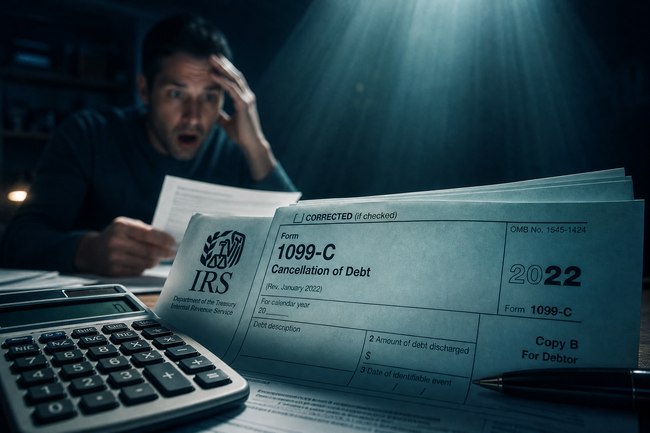
Many people master how to negotiate a debt settlement only to be shocked at tax time. From a CPA’s perspective, it is vital to understand how the IRS views forgiven debt.
According to IRS Topic 431, Canceled Debt — Is It Taxable or Not?, the $600 figure is generally an information-reporting threshold for Form 1099-C in many situations, not a universal rule that every canceled debt above that amount is taxable. Whether canceled debt is taxable depends on the facts and available exclusions, including insolvency or bankruptcy. For example, if you owe $10,000 and settle for $4,000, the remaining $6,000 may be canceled debt that must be evaluated under the applicable tax rules.
When the applicable information-reporting rules require it, the creditor may report the canceled debt to the IRS and send you a Form 1099-C (Cancellation of Debt) early the following year. As the IRS explains in its guidance on forgiven debt, receiving a Form 1099-C does not by itself determine whether the amount is taxable; evaluate and report the debt under the applicable tax rules and exclusions.
Learning how to negotiate a debt settlement also means understanding the tax consequences of forgiven debt. Before you finalize any settlement, read our complete guide on paying taxes on settled debt and Form 1099-C so you can plan for the potential tax bill before it arrives.
The Insolvency Exception
There is a significant exception that can save you from paying taxes on forgiven debt: Insolvency, subject to the applicable tax rules and exclusions.
If you were insolvent immediately before the debt was settled, you may be able to exclude the forgiven debt from your taxable income. You are considered insolvent when your total liabilities (what you owe) exceed the total fair market value of your assets (what you own).
For example, if your total debts (including the debt being settled, mortgage, car loans, etc.) equaled $50,000, and your total assets (home equity, bank accounts, vehicles, retirement accounts) equaled $30,000, you were insolvent by $20,000.
If your forgiven debt was $6,000, you can completely exclude it from your income because your insolvency ($20,000) was greater than the forgiven amount ($6,000).
To claim this exception after you learn how to negotiate a debt settlement, you must file IRS Form 982 with your tax return. Because tax laws surrounding canceled debt are complex, we strongly recommend consulting with a qualified tax professional or CPA to ensure you properly calculate insolvency and file the correct forms.
Filing Form 982 correctly is the key to avoiding taxes on your forgiven debt. Our step-by-step guide to the IRS insolvency worksheet walks you through every line of the form and shows you exactly how to calculate whether you qualify for the exclusion.
Frequently Asked Questions (FAQ)
Does debt settlement hurt my credit score? Yes — and any honest guide on how to negotiate a debt settlement should acknowledge this. To settle a debt, an account may first become delinquent, which can hurt credit scores and reporting; the effect varies by account and reporting history. Furthermore, a “settled” status on your credit report indicates that you did not pay the full agreed-upon amount. A settled status is not the same as paid in full, and whether settlement is better than continued delinquency or bankruptcy depends on the person’s facts; rebuilding can begin after settlement, but recovery time varies.
Before finalizing any agreement, it is crucial to understand how to negotiate a debt settlement and the long-term impact that follows from how to negotiate a debt settlement under your specific circumstances. Many people wonder, does debt settlement hurt credit? The answer is yes, but knowing the real timeline for recovery can help you make an informed decision.
Can I negotiate a debt settlement myself? Absolutely. Learning how to negotiate a debt settlement yourself means you do not need to pay a debt settlement company 15% to 25% of your debt in fees. By dealing directly with creditors, you save money and maintain control over the process.
What percentage should I offer to settle a debt? When planning how to negotiate a debt settlement offer, 20% to 30% can be used as an illustrative opening range, but it is not a universal starting point or guarantee. Expect the creditor to counteroffer. An illustrative completed-settlement range may be 40% to 60% of the original debt, depending on the age of the debt, the creditor, and the agreement; actual outcomes vary.
What happens if I miss a payment on a settlement plan? This is one of the biggest risks in how to negotiate a debt settlement payment plan. The effect of a missed payment depends on the written settlement agreement: the creditor may void or modify the arrangement, charge fees, or change what remains due, but the original balance is not automatically restored in every case. Review the agreement and contact the creditor promptly. This is one reason lump-sum settlements may be simpler to administer.
Will I owe taxes on my settled debt? A canceled-debt amount of $600 or more may trigger information reporting and a Form 1099-C in many situations, but that figure is not a universal taxability rule. Whether you owe tax depends on the facts and available exclusions. If you were insolvent at the time of the settlement, you may be able to exclude some or all of the canceled debt using IRS Form 982.
How to Negotiate a Debt Settlement Successfully: Final Thoughts
Knowing how to negotiate a debt settlement requires patience, preparation, and persistence. By understanding your financial limits, validating your debts, using effective negotiation scripts, and protecting yourself with written agreements, you can successfully reduce your debt burden.
Do not let the fear of taxes deter you from learning how to negotiate a debt settlement; understanding the insolvency exception can protect you from an unexpected tax bill. Take the first step today by assessing your finances and preparing your initial offers.
Join Our Newsletter
From time to time, we’ll send you information and resources that we believe may be helpful to you.
Subscribe to The Debt Survival Guide Newsletter
Disclaimer: The Debt Survival Guide provides educational content only. We are not attorneys, tax professionals, or financial advisors. This information should not be considered legal, tax, housing, credit, or individualized financial advice. Circumstances, agreements, deadlines, laws, and available options vary by person, account, location, and situation. Please review your records and written terms and consult a qualified attorney, legal-aid organization, HUD-approved housing counselor, tax professional, credit counselor, or financial professional before making decisions about your specific situation.
References
[1] Internal Revenue Service. Topic no. 431, Canceled debt — Is it taxable or not?
[2] Internal Revenue Service. What if my debt is forgiven?